

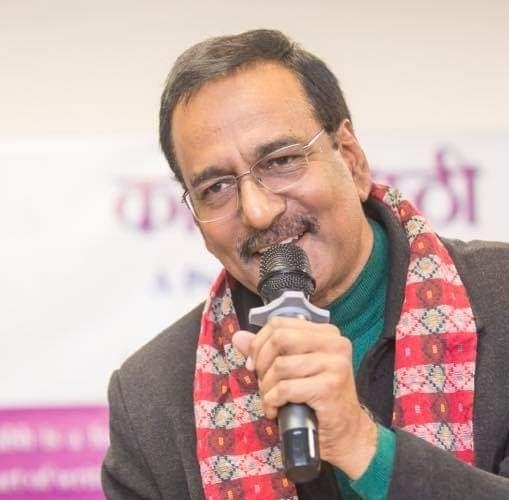

Rajendra Shalabh
@a1752591-9010-4b0a-93ab-16207a15ca1a · Lyricist, Film Director
Rajendra Shalabh (also credited as Rajendra Salav) is a veteran Nepali filmmaker and lyricist whose career spans cinema, literature, media, and cultural programming. Active since 1990, he has directed notable Nepali films such as Bijaya Parajaya (199...
Biography
Rajendra Shalabh (also credited as Rajendra Salav) is a veteran Nepali filmmaker and lyricist whose career spans cinema, literature, media, and cultural programming. Active since 1990, he has directed...
Personal Info
Career Highlights
1
Films
—
Awards
36 yrs
Experience
—
Rating
Similar Artists
Artists you might also like

Rishi Raj Acharya is one of Nepal’s most respected film directors, known for blending social realism, cultural depth, and emotional storytelling in modern Nepali cinema. Born on September 14, 1978, in Tulsipur, Dang, he has shaped a distinct directorial identity by treating cinema not just as entertainment but as a medium of social awareness, cultural preservation, and personal expression.Acharya’s filmmaking journey is rooted in his academic background—he holds a Master’s degree in Sociology, which deeply influences his narrative style. His films often explore themes of migration, rural life, tradition, identity, and the changing social fabric of Nepal.He is also actively involved in the Nepali film community as a member of the Film Directors’ Guild of Nepal and the Film Artist Workers’ Organization of Nepal (FAWON).
Rishi Raj Acharya
Film Director

Ram Man Trishit, also known as Ram Man Shrestha, was a renowned Nepali lyricist celebrated for his contributions to modern Nepali music. Born around 1941, he was not only a gifted lyricist but also a medical doctor by profession. His lyrics were often brought to life by composers like Shiva Shankar and singers such as Tara Devi and Narayan Gopal. Some of his notable songs include: "Dilma Hajur Ayera" (sung by Tara Devi) "Mancheko Maya Yaha" (sung by Narayan Gopal and Gyanu Rana) "Yek Phool Jharera Ke Bho" (sung by Tara Devi) He passed away on May 31, 2011, leaving behind a legacy of timeless music.
Ram man trishit
Lyricist

Deependra Gauchan is a renowned Nepali film director, screenwriter, and producer who has made significant contributions to the film industries of both Nepal and Cambodia. Contributions in Nepal "Ujeli: A Child Bride in Nepal": This social tragic drama, directed by Deependra Gauchan and produced by UNICEF, highlights the issue of child marriage in Nepal. The film portrays the life of a 10-year-old girl forced into an arranged marriage, shedding light on the sharp distinctions between the roles of boys and girls in Nepal. Other Works: Deependra has also worked on various other projects, including "Sneh Svaikun 4" and "Viplas/Rachana," showcasing his versatility and dedication to the Nepali film industry. Contributions in Cambodia "Love 2 the Power of 4": Deependra co-directed this Khmer-language romantic comedy alongside Cambodian co-director and co-writer Sothea Ines. The film explores the relationships of four young, middle-class Cambodian couples as they navigate their professional and romantic aspirations. It addresses sensitive issues such as relationships between transgender people, trauma, suicide, and abortion, making it a significant contribution to Cambodian cinema. Deependra Gauchan's work in both Nepal and Cambodia has been instrumental in addressing social issues and promoting cultural narratives through film. His dedication to storytelling and his ability to tackle complex themes have made him a respected figure in the film industry.
Deependra Gauchan
Film Director

Hira Singh Khatri is regarded as one of the earliest architects of Nepali cinema, best known for directing Aama (1964), the first Nepali feature film produced in Nepal under the Royal Nepal Film Corporation. His work marked the formal beginning of Nepal’s national film industry, establishing narrative, technical, and production standards for future filmmakers. Khatri later directed Hijo Aaja Bholi (1967), further strengthening the foundation of Nepali storytelling on screen. His films emphasized patriotism, social values, and emotional realism, influencing a generation of emerging directors. As a pioneering figure who helped transition Nepal from stage and radio culture into cinematic expression, Hira Singh Khatri’s contribution remains a defining milestone in the history of Nepali filmmaking.
Hira Singh Khatri
Film Director